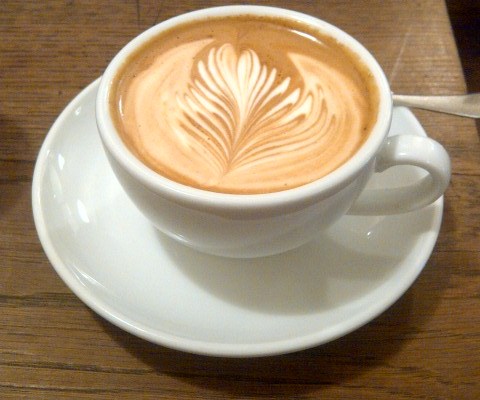

I was at the airport, readying to board my first ever flight to Australia – a business trip, so I occupied myself with work. I couldn’t believe my eyes when I noticed Google’s doodle for that day: a coffee cup with an artistic milk pattern on top. The focus for that Monday was the flat white – a craft coffee I was researching only a day earlier, vaguely familiar with its Aussie roots. It was meant to be!

What it is
A flat white is an espresso-based coffee drink originating from Australia or New Zealand.
Its exact origins are a bit ambiguous, but it’s generally believed to have been born in the 1980s in Sydney, Australia, while others pinpoint Wellington, New Zealand. The drink gained popularity in both countries before spreading to other parts of the world, becoming a staple in many coffee shops globally.
From my barista experience, it consists of two shots of espresso mixed with steamed milk at a 50/50 ratio, making it a size in between a cortado (espresso “cut” with a splash of milk) and a latte.
The milk – usually whole milk for the fat and protein content – is steamed in a uniform way to create a velvety microfoam, giving the drink a smooth and creamy texture – allowing for the signature latte art to finish off the presentation. The flat white is often enjoyed for its strong yet mellow taste.
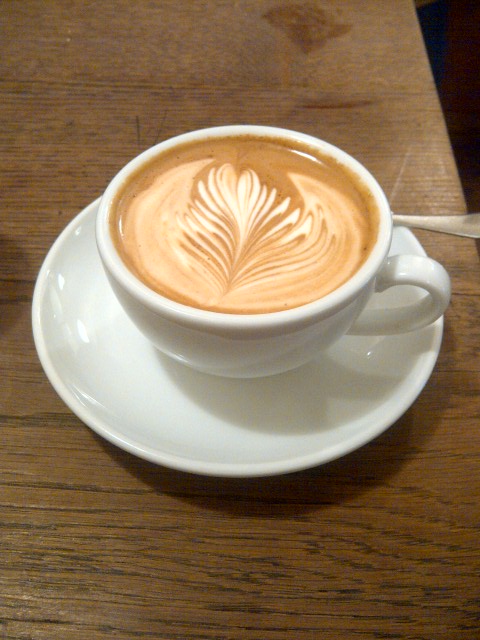
It was when I worked at the high street coffee chain, when the flat white was introduced to the menu for the first time – and so was latte art. Besides learning the recipe (which in itself was very straightforward), the training now included a new milk steaming technique, which was much more hands-on than for a cappuccino, where 50% of the milk should be foam, and therefore requires more attention than a latte. A new, shallower cup was introduced into the serveware to facilitate the blending of the espresso and milk in such a way that the barista was able to “draw” a love heart or – if more experienced – a rosette by modulating the pour with a hand elevation and wriggle of the wrist.
Even as passionate as I was about crafted coffee by then, I felt hopeless in those early days, struggling to present anything more artistic than a heart – and didn’t even get me started on skimmed milk or soya!
I learnt a lot then about patience and “practice makes perfect”, but more importantly, the characteristics of different milk varieties and how they react to steaming. I will explore this in a separate post, but the key factor is the aforementioned fat and protein molecules which, in layman’s terms, become “sticky” under heat. The more of them in the milk, the denser the texture, meaning a freehand milk pour is less likely to be split by the similarly viscous espresso. Think of it as pouring a bucket of paint into a half-full one – gravity will cause the poured paint to goto the bottom first, but with continuous pour it will soon emerge to the top.
It was in those early days that we were advised the drink came from Australia, but I never explored the topic further – until this day, as I was heading there for my maiden visit.
Aussie coffee scene
Online research suggested Australia has a vibrant coffee culture with a strong tradition of espresso-based drinks. Despite the famed laid-back attitude, Australian cafes are known for their commitment to serving high-quality coffee, and the demand for innovative coffee drinks is high.

Another factor influencing the country’s coffee passion were Italian immigrants in the mid-20th century. They brought with them an appreciation for espresso-based drinks, laying the foundation for the popularity of craft brews like the flat white.
Australian baristas and coffee enthusiasts are known for their willingness to experiment with different coffee recipes and techniques. It’s plausible that the flat white emerged as a result of this culture of innovation, with baristas seeking to create a drink that offered a unique balance of espresso and milk.
While the flat white is perhaps the most internationally recognised coffee originating from Australia, there are a few other lesser know beverages that have gained popularity down below:
- Long Black – made by pouring a shot of espresso into hot water. It is similar to an Americano, in which hot water is poured into shot of espresso.
- Piccolo Latte – also known as 3/4 Latte, is a small coffee made with a shot of espresso topped with steamed milk, served in a small glass. It’s similar to a macchiato but with a slightly larger volume of milk.
- Magic – a relatively recent addition to the coffee scene, believed to have originated in Melbourne, Australia. It’s made with a double shot of ristretto (a stronger version of espresso) mixed with steamed milk, typically served in a smaller cup than a latte. It is known for its velvety texture and strong coffee flavour.
And the one for diet aficionados:
- Fat Black or Bulletproof Coffee – made with coconut oil or a similar. This beverage typically consists of brewed coffee blended with a source of healthy fat, such as coconut oil, grass-fed butter or ghee. Some variations may also include other additions like collagen peptides or MCT (medium-chain triglyceride) oil.
Bulletproof Coffee came to prominence in recent years as a drink that provides sustained energy and mental clarity, thanks to the combination of caffeine from the coffee and the slow-burning fats. Advocates claim that it can help with weight loss and improved energy levels, but scientific evidence supporting these claims is limited – so don’t go rushing to your neighbour bio shop expecting miracles!
Have you tried any of the above? What did you think? Pop your thoughts into the comments section under this post.
And look out for the next entry – this one from my whistle stop tour of Perth, WA’s coffee scene, where I put the above claims to the test…
 A Black Spot
One thought on “Flat White ”